


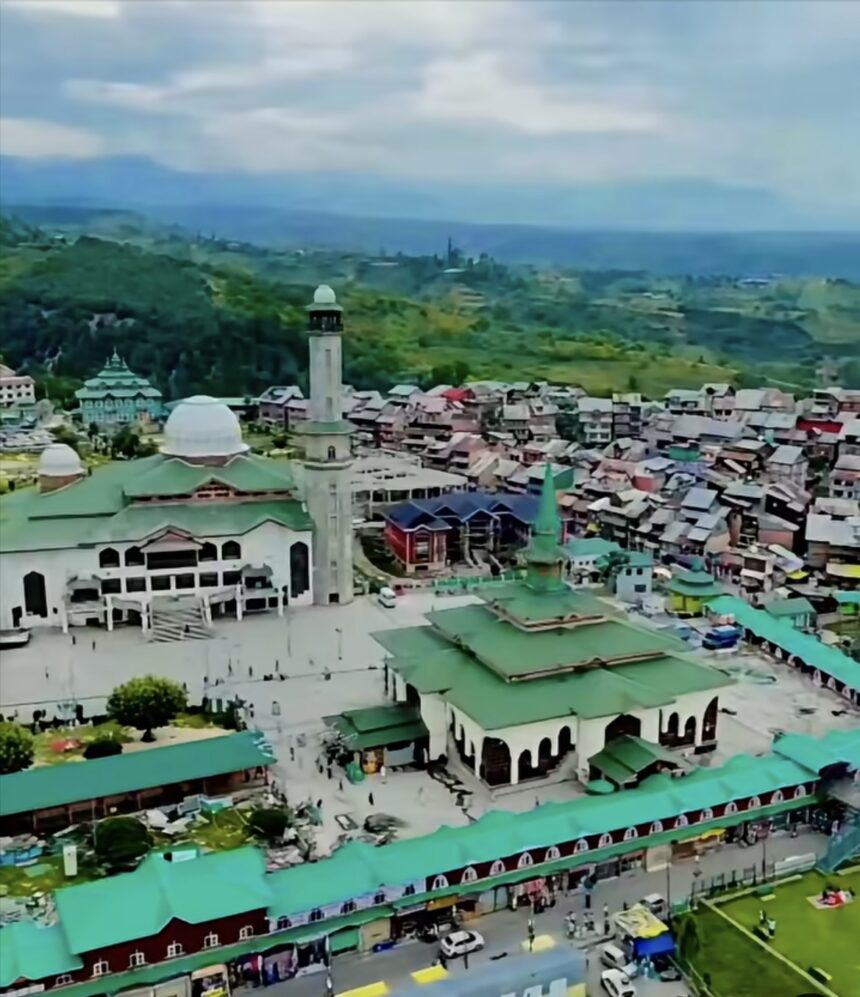
STRUCTURING THE DEVASTATED
Rebuilding a shrine is not merely a construction exercise; it is the restoration of a civilisation’s memory.
By GEO NATIONAL NEWS
❖ ❖ ❖

There are places in Kashmir that are more than places. They are repositories of memory, conscience and civilisational continuity. Charar-i-Sharief is one such place. The Ziyarat of Hazrat Sheikh Noor-ud-Din Noorani (R.A.), the Alamdar-e-Kashmir, is not merely a shrine of stone, timber and prayer; it is a spiritual grammar in which Kashmir has long narrated its deepest ideas of compassion, restraint, simplicity, knowledge and coexistence.
The tragedy of 1995 reduced the shrine and its surroundings to a landscape of devastation. What followed was not simply the physical reconstruction of a building but a prolonged period in which the dignity of the wider shrine precinct seemed to lag far behind the sanctity of the saint to whom it belonged. For years, the visitor could see an uneasy coexistence between a sacred centre of immense spiritual stature and facilities that were plainly inadequate for the people who came to it.
The contrast today is striking. During the last few years, and particularly under the present stewardship of the Jammu & Kashmir Waqf Board, the Charar-i-Sharief complex has witnessed a transformation that is difficult to ignore. The Board itself has publicly described the development at Charar-i-Sharief over the past three years as a major infrastructural transformation, while recent reports record the inauguration of new utility facilities at the shrine complex.
One need not romanticise the past to appreciate how far the place has travelled. Public conveniences that once suffered from precarious construction, leaking tin roofs and unfortunate placement have given way to substantially better sanitation and ablution facilities. The approach from the old bus stand, once a rough and pothole-ridden passage, is now being conceived as a dignified ceremonial and pedestrian axis. Parks, covered passages, women-oriented facilities, improved utility spaces and more purposeful structures have altered the experience of the pilgrim.
The difference is perhaps best understood through the eyes of an ordinary visitor. A devotee should not have to choose between devotion and basic dignity. A woman participating in wanwun should not have to negotiate winter cold or summer heat simply because the sacred precinct lacks an appropriate space. A pilgrim should not be compelled to search for a tolerable washroom. A guest should not feel that the only sensible option is to leave the spiritual environs because there is nowhere decent to sit, rest or stay.
That is why the present transformation deserves appreciation. It demonstrates that Waqf resources, when placed within a purposeful administrative framework, can be converted into public utility without diminishing the sanctity of the institution. The emphasis on cleanliness, infrastructure, visitor facilities and disciplined management is not cosmetic. It is an expression of respect for the people who come to the shrine and, ultimately, respect for the saint whose name draws them there.
The credit for this change must, therefore, be placed where it is due. Dr. Syed Darakhshan Andrabi, Chairperson of the Jammu & Kashmir Waqf Board, has brought to shrine management an approach that combines administrative urgency with an appreciation of heritage. Her public interventions at Charar-i-Sharief, including the inauguration of a new utility centre and the stated plan for a Bait-ul-Zayireen, indicate an institutional willingness to keep the work moving rather than allow it to become another perpetual project.
What is particularly encouraging is that this is not an isolated philosophy. Across J&K, Dr. Andrabi has repeatedly stressed cleanliness, public amenities, timely execution and preservation of spiritual heritage in shrine development. The wider programme of renovation and beautification gives reason to believe that Charar-i-Sharief can be taken to the next level as a model of integrated shrine management.
A successful first phase should not become the final phase. Once the major stains of neglect have been removed, the smaller but visually and institutionally important deficiencies become more visible. Charar-i-Sharief now deserves a second-generation development plan: one that moves from basic revival to architectural coherence, heritage presentation, urban discipline and intellectual outreach.
The first priority should be the precinct associated with Hazrat Sangram Dar. The entrance shrine and its immediate surroundings ought to receive an architectural treatment commensurate with the principal Ziyarat. Significantly, a formal Public Works Department tender for the revival and restoration of Sangram Dar Sahib Shrine was issued in August 2026, showing that this need has already entered the formal development process. The opportunity now is to ensure that the execution is aesthetically sympathetic, durable and worthy of the setting.
Second, the sabat lane and its shops require a strict and uniform design code. Shopkeepers should not be left to improvise the visual language of a sacred precinct. Signage, shutters, colours, lighting, display arrangements, waste disposal and façade treatment can all be governed by a simple architectural manual. The purpose would not be to suppress livelihood; it would be to make livelihood compatible with heritage.
Third, the Waqf shops at the main bus stand need comprehensive renovation. The makeshift structures in front of the shrine should be rationalised and, wherever feasible, relocated into planned commercial spaces. Old and shabby structures that currently house temporary commerce should be rebuilt in a coherent architectural vocabulary. Public land and pedestrian space must not become collateral victims of unregulated vending.
The old bus stand itself deserves a carefully designed public-realm intervention. A circular fountain, with a properly planned ablution facility around it, could become the visual centre of the space. The idea is not to create ornament for ornament’s sake; it is to create an identifiable civic forecourt from which the visitor experiences the shrine as a dignified spiritual destination rather than as a congested commercial junction.
A calibrated façade and signage scheme for all shopkeepers could complete this transformation. Every establishment should be required to maintain cleanliness, lighting, frontage, colour discipline and waste management. In a shrine town, the street is part of the pilgrimage experience. The bazaar cannot be permitted to visually contradict the sanctity of the Ziyarat.
Yet there is one proposal that, in my view, would give the entire project a deeper intellectual meaning. At the entrance to the sanctum sanctorum, the Waqf Board should establish a dedicated Sheikh-ul-Alam Book Centre — a carefully curated space carrying works on Sheikh Noor-ud-Din Noorani (R.A.), the Rishi tradition, Kashmir’s Sufi literature, the lives and teachings of the Awliya-e-Kiram and Rishis of Kashmir, and reliable works on the history, philosophy and poetry of the valley.
The shrine should not merely receive readers; it should produce them. A pilgrim who arrives with flowers and prayers should be able to leave with a book. A student should be able to discover the thought of Sheikh-ul-Alam in accessible English, Urdu and Kashmiri. A visitor from outside Kashmir should be able to understand why Nund Rishi occupies such a singular place in the intellectual and spiritual imagination of the region.
Sheikh Noor-ud-Din Noorani (R.A.) was not only a saint of devotional memory. He was a thinker, poet, teacher ,an ducationist, a social engineer ,a political thinker , an environmentalist and a moral voice whose sayings and verses formed a vocabulary of ethical living. His message belongs not merely to a shrine or a community; it belongs to the intellectual history of Kashmir. To present him adequately is therefore an act of scholarship as much as an act of reverence.
The next logical step would be an architecturally distinguished auditorium and conference facility somewhere within the broader shrine precinct, planned with sensitivity to heritage. National and international conferences on Rishism, Sufism, Kashmiri literature, comparative spirituality, peace studies, interfaith dialogue, ecology and the intellectual history of Kashmir could be held there. Charar-i-Sharief could become a meeting place for scholars rather than merely a destination for pilgrims.
Such a facility would also realise an idea that is particularly relevant to contemporary Kashmir that its spiritual inheritance should be communicated, studied and debated in the language of scholarship. The Rishi tradition is one of Kashmir’s most persuasive contributions to the world’s conversation about coexistence. Its universal vocabulary deserves a universal platform.
Dr. Darakhshan Andrabi deserves appreciation for demonstrating that institutions can move with speed when leadership possesses clarity of purpose. But leadership is also measured by the ability to recognise what comes next. Charar-i-Sharief has crossed the threshold from neglect to renewal. It must now cross another threshold: from renewal to excellence.
I therefore beseech Dr. Andrabi to take personal interest in the remaining architectural, civic and intellectual components of this vision — the dignified treatment of Sangram Dar Sahib’s precinct; a disciplined façade and design code for the sabat shops; comprehensive renovation of Waqf commercial properties; rationalisation of the old bus stand; removal of encroachments and visual clutter; a landmark fountain and ablution concept; a Sheikh-ul-Alam Book Centre; and, ultimately, a state-of-the-art auditorium to be named Sheikh ul Alam Auditorium and research/conference platform dedicated to the intellectual heritage of Kashmir.
These are not demands for embellishment. They are proposals for completing a historical sentence that began with destruction, passed through reconstruction and has now reached the stage of renaissance.
A person standing at the centre of the sanctum sanctorum and turning 360 degrees should ideally encounter cleanliness, order, beauty, dignity and spiritual calm. That should be the governing philosophy of the entire precinct — not merely the building at its centre.
The rebuilding of Charar-i-Sharief has already shown what determined stewardship can achieve. The next task is to make its surroundings worthy of the shrine, its public spaces worthy of its pilgrims, and its intellectual institutions worthy of Sheikh Noor-ud-Din Noorani (R.A.).
The finest service we can render to our Sheikh (R.A.) is not only to rebuild his shrine in stone and timber, but to rebuild the intellectual bridge through which his thought reaches the next generation. Let Charar-i-Sharief become once again what it has always had the potential to be: a sanctuary of faith, a school of wisdom, a museum of Kashmiri civilisation and a living embassy of the Rishi-Sufi ethos.
|
“The finest service we can render to our Sheikh (R.A.) is not only to rebuild his shrine in stone and timber, but to rebuild the intellectual bridge through which his thought reaches the next generation.” |
By Editorial Team: GEO National News .